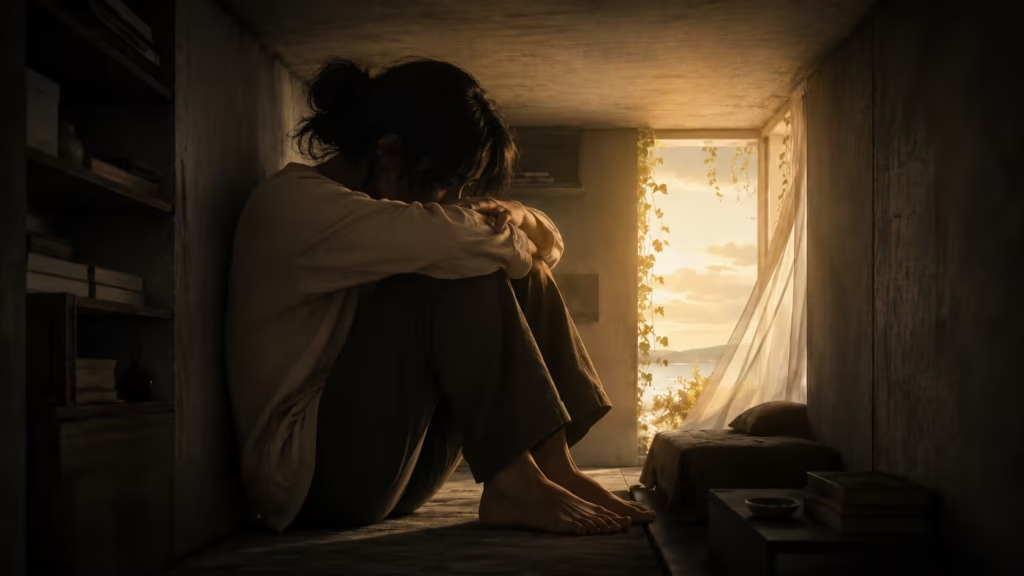
Part I — The Invisible Weight
Notes from a room that finally let me breathe
I did not know how heavy the old place was
until my body stopped bracing itself
in the new one.
It was not one thing.
Not a single disaster.
Not a dramatic collapse.
It was the air.
The mornings that disappeared before I could enter them.
The silence that never rested.
The rooms that held my body,
but never really held me.
For a long time, I thought I was simply tired.
Maybe I was behind.
Maybe I was too sensitive.
Maybe I lacked discipline.
Maybe this was just what life felt like at this stage — heavy, fragmented, strangely difficult to begin.
I woke up and time was already gone.
There were simple things I wanted to do.
Make breakfast.
Open a drawer.
Clear a surface.
Take a breath before the day started asking for pieces of me.
But somehow the morning would vanish.
Nothing dramatic had happened.
No storm had entered the room.
No one had knocked on the door with terrible news.
And yet I was already exhausted.
This is one of the quietest forms of heaviness:
the kind that does not announce itself as suffering.
It does not arrive with a name.
It does not always look like crisis.
It does not always give you a clear reason to point at and say,
there — that is what hurts.
Sometimes the weight is atmospheric.
It lives in the walls, but not literally.
It lives in memory.
In repetition.
In the way your body has learned to enter a room and prepare itself.
In the way your shoulders rise before you know why.
In the way your mind begins scanning before the kettle has boiled.
A place can become associated with vigilance.
Not because it is evil.
Not because anything supernatural is happening.
Not because the walls themselves have turned against you.
But because the body remembers.
It remembers what happened there.
It remembers how often you swallowed your words.
How many mornings began with dread.
How many evenings ended without true rest.
How often you told yourself, just get through this day.
The mind can rationalize almost anything.
It can say:
This is fine.
This is temporary.
This is normal.
Other people have it worse.
You are overreacting.
You should be grateful.
You should be stronger.
But the body keeps a quieter record.
The body knows the difference between rest and collapse.
Between silence and safety.
Between being alone and being abandoned by yourself.
Between a home that shelters you
and a place where you are constantly preparing for something unnamed.
I did not fully understand this until I left that place.
Then something strange happened.
Not spectacular.
Not cinematic.
No lightning split the sky.
No angel appeared at the window.
No great revelation arrived with golden handwriting.
I simply woke up.
I walked the dog.
I came back.
I washed.
I cleaned the bathroom.
I sorted small things.
I dealt with practical things.
I made breakfast.
I prepared food for work — something I almost never do.
Then I still had time.
Time.
That was the first miracle.
Not happiness.
Not success.
Not a grand new life perfectly arranged.
Time.
A pocket of morning that did not disappear.
A cup of tea that did not feel stolen from emergency.
A body that moved from one simple thing to another without dragging a mountain behind it.
And I thought:
What is happening?
The day had not become longer.
The clock had not become kinder.
The world had not suddenly solved itself.
Something had simply stopped consuming me
before I even began.
This is what we often fail to understand about environments.
They are not neutral.
A room speaks.
A street speaks.
A building speaks.
A bed, a window, a kitchen, a corridor — they all become part of the nervous system’s map.
The body listens long before the mind creates an explanation.
Some places ask us to contract.
Some places ask us to perform.
Some places keep us in an old version of ourselves, even when we are trying to become someone new.
And some places — quietly, without ceremony — say:
You can put it down now.
Not everything.
Not forever.
Not all your history, all your fear, all your unfinished grief.
But something.
The invisible weight.
The bracing.
The constant inner leaning against impact.
Sometimes healing does not begin with a plan.
Sometimes it begins with a room where your shoulders drop.
A room where the morning enters differently.
Where the light does not feel like interrogation.
Where silence is not a threat.
Where the body does not wake up already negotiating with the day.
A place does not have to be perfect to be healing.
It does not have to be beautiful in a magazine way.
It does not have to be finished, decorated, polished, or explained.
It only has to offer the body a different message.
Not:
prepare.
But:
arrive.
Not:
hold yourself together.
But:
you are allowed to soften here.
This is not always easy to trust.
When you have lived for a long time in tension, peace can feel suspicious.
The nervous system may keep checking the corners.
The mind may whisper: do not relax too soon.
Do not believe it.
Do not become foolish.
Do not get used to this.
Because disappointment has trained you to distrust relief.
But still, the body knows.
It knows in the small things.
In breakfast made without panic.
In a drawer opened without dread.
In a walk that becomes a walk, not just another task.
In the strange, almost shocking desire to see people again.
To sit somewhere.
To drink a glass of wine.
To be in the world without feeling invaded by it.
These are not small things.
They are evidence.
Quiet evidence.
Domestic evidence.
Holy evidence, almost.
Proof that something in you was not broken.
It was burdened.
Proof that your exhaustion was not your personality.
Your paralysis was not laziness.
Your lack of time was not always a failure of discipline.
Sometimes the self cannot return
while the body is still standing guard.
And sometimes, when the guard finally lowers its weapon,
life comes back in ordinary gestures.
The tea.
The breakfast.
The clean bathroom.
The dog walk.
The little bit of extra time before work.
Nothing dramatic.
Everything changed.
I do not know yet what this new life will become.
I do not want to make declarations too early.
I do not want to turn a fragile peace into a performance.
I do not want to demand from this place that it saves me.
But I can say this:
Something in me has exhaled.
And maybe that is where every true beginning starts.
Not with certainty.
Not with a perfect plan.
Not with a loud announcement.
But with the body realizing
it no longer has to fight the room it is standing in.
Reflection
Maybe we do not always need to become stronger.
Maybe sometimes we need to notice
where we have been forced to stay strong for too long.
And maybe the first sign of healing
is not joy, not clarity, not courage —
but the quiet return of simple things.
Breakfast.
Breath.
Time.
A door that closes gently.
A room that finally lets you be.
My body recognized a place
where it no longer had to fight.